Have a question for our experts to answer?
Submit it to our experts. We’d be happy to help.
Method development is the first real moment of truth in a bioanalytical project. It sets the trajectory for everything that follows, from validation to sample analysis to final reporting.Over the next 12 weeks, our subject matter experts will share practical insights, real-world examples, and regulatory perspectives showing you how to excel your method development.
Join the discussion on LinkedIn or check back to this page each week for fresh content and tools.
Have a question you’d like answered? Submit it to our experts. We’d be happy to help.
Method development is the first real moment of truth in a bioanalytical project. It sets the trajectory for everything that follows, from validation to sample analysis to final reporting.
And yet, one of the most common challenges we see is not technical. It is alignment.
Strong method development does not start in the lab. It starts with what the sponsor brings into the conversation.
A well-developed method is not just about sensitivity or selectivity. It is about fitness for purpose.
If the foundation is unclear, teams end up iterating, reworking, and losing time. In early development programs, that time matters.
The difference between a smooth program and a reactive one often comes down to the quality of inputs at the start.
What decisions will this data support? This sounds simple, but it drives everything:
Without this, method development becomes guesswork.
Basic characterization is critical:
Any previous observations helps the lab anticipate challenges early.
Where will this method be applied?
Matrix drives complexity. Tissue and microsampling require very different approaches than standard plasma work.
Even rough estimates are valuable:
This informs assay range and avoids rework when real samples arrive.
Availability and quality matter:
Delays here can stall development entirely.
Is this:
The level of rigor and documentation changes based on intended use.
Be explicit:
This helps labs allocate resources appropriately and avoid surprises.
Most issues we see are not capability gaps. They are communication gaps.
These lead to avoidable delays and rework.
The most successful programs share a common approach:
Method development is not a transactional step. It is a strategic one.
If you want speed, quality, and reliability downstream, invest the time upfront. The best bioanalytical methods are not just developed. They are built on clarity.
Looking for more information on method development?
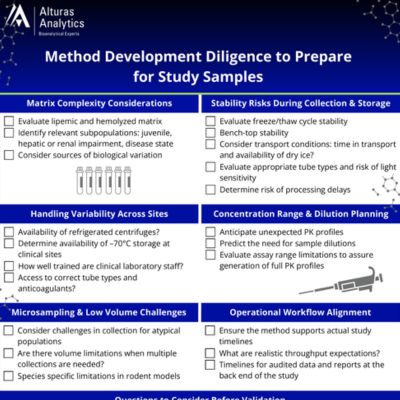
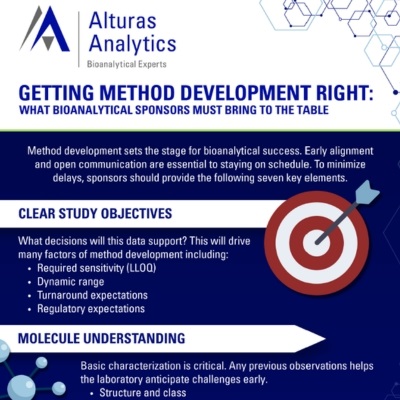
Download the “Getting Method Development Right: What Bioanalytical Sponsors Must Bring to the Table” Infographic
An easy-to-use reference that highlights seven key elements
Submit Your Method Development Questions to Our Scientific Experts
Throughout this series, our team will be answering real questions in short-form videos and commentary. No fluff — just real insights from the field. Have something you’ve always wanted explained more clearly? Curious how these concepts apply to your specific challenge? Now’s the time to ask.

Chad has over 24 years of related experience as an analytical scientist with over 20 years focused on bioanalysis at Alturas Analytics. Chad is responsible for supervision of the analytical method development team in supporting method validations and sample analysis and Study Director/Principal Investigator on GLP and clinical studies, providing technical oversight to clients across all therapeutic areas.
"*" indicates required fields